
Dementholized Mint Oil, commonly known as DMO, is a mint-derived oil obtained after part of the naturally occurring menthol has been removed from Mentha arvensis oil.
DMO is not a synthetic mint flavor and it is not a menthol-free material. It remains a multi-component mint oil containing menthol together with other naturally occurring mint aroma components.
Understanding how DMO is produced helps explain why it still contains menthol, why its aroma differs from isolated menthol, and why it is useful in professional flavor and aroma formulations.
Mentha arvensis, also known as cornmint or field mint, is an important natural source of mint oil and menthol.
The essential oil obtained from the plant contains a mixture of volatile aroma compounds. Menthol is one of its major components, together with other mint-related constituents such as menthone, isomenthone, menthyl acetate, limonene and minor aroma compounds.
The exact composition can vary depending on botanical variety, growing conditions, origin, harvest period and processing conditions.
The process begins with Mentha arvensis plant material.
Steam distillation is commonly used to recover the volatile essential oil from the plant. The resulting material is a menthol-rich natural mint oil containing menthol together with a range of other aromatic components.
At this stage, the material is still Mentha arvensis oil and has not yet been dementholized.
After distillation, the mint oil is cooled under controlled processing conditions.
As the temperature decreases, part of the menthol present in the oil begins to crystallize.
This cooling process allows part of the menthol to be separated from the liquid mint oil while many of the other natural aroma components remain in the oil phase.
During continued cooling, menthol crystals gradually form in the oil.
The crystallization step removes a substantial portion of menthol, but it does not remove all menthol from the oil.
This is an important point when understanding DMO. The term dementholized means that part of the menthol has been removed. It does not mean that the oil is completely free of menthol.
After sufficient crystallization, the solid menthol crystals are separated from the remaining liquid oil.
The process produces two different fractions:
The remaining oil still contains menthol together with other naturally occurring mint aroma components.
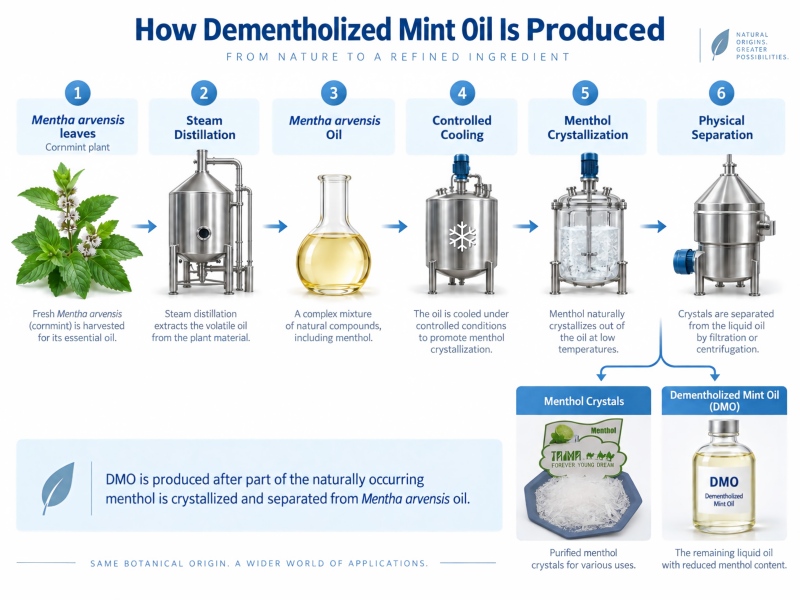
The overall production route can be summarized as follows:
Mentha arvensis plant
↓
Steam distillation
↓
Mentha arvensis oil
↓
Controlled cooling
↓
Menthol crystallization
↓
Physical separation
↓
Menthol crystals + Dementholized Mint Oil
One of the most common questions about DMO is why a product described as "dementholized" still contains menthol.
The reason is that dementholized does not mean menthol-free.
The crystallization and separation process removes only part of the menthol. A certain amount remains dissolved in the liquid oil together with the other mint aroma components.
For TAIMA's current Dementholized Mint Oil specification, the menthol content is 30%-45%. Batch-specific results can be confirmed by the corresponding Certificate of Analysis.
The remaining menthol contributes to the characteristic fresh mint profile, while the other components help provide a broader aroma than isolated menthol alone.
Dementholized Mint Oil remains a multi-component mint oil after partial menthol removal.
Depending on the raw material and processing conditions, typical components may include:
The exact composition can vary between different raw materials and batches.
Because these components remain together in the oil, DMO provides a broader mint aroma profile than a single isolated menthol material.
Dementholized Mint Oil and menthol crystals are related to the same mint processing chain, but they are different types of materials.
DMO is therefore better understood as a multi-component mint oil rather than simply a liquid form of menthol.
DMO can be useful when a formulation requires both freshness and a broader mint aroma rather than only the sensory characteristics of isolated menthol.
Typical application areas may include:
The final sensory effect depends on dosage, formulation structure and interaction with other flavor ingredients.
For commercial evaluation, buyers should consider both the general product specification and batch-specific information.
A batch-specific COA can be used to confirm whether the supplied material meets the required specification before commercial use.
No. DMO is partially dementholized. Part of the menthol is removed, while a certain amount remains in the liquid mint oil.
Yes. DMO is commonly obtained from Mentha arvensis oil after part of the naturally occurring menthol has been crystallized and separated.
Mentha arvensis oil is an important natural source of menthol. Cooling and crystallization allow part of the menthol to be separated as crystals while leaving behind a liquid mint oil containing other aroma components.
Yes. Because DMO retains menthol together with other mint oil components, it maintains a characteristic fresh mint aroma after partial dementholization.
For detailed product specifications, technical documents and sample evaluation information, please visit our Dementholized Mint Oil product page.
Contact us for price, sample, MOQ and OEM support.
✔ Reply within 12 hours
Get Quote on WhatsApp Request SampleWhatsApp: +86 15619038117
Email: alina@taimacn.com
 Alina
Alina