
Natural Menthol and L-Menthol are often treated as interchangeable terms, but technically they describe two different aspects of a menthol product.
Natural Menthol describes the origin of the material, while L-Menthol describes a specific stereochemical form of the menthol molecule.
Understanding this distinction is important for buyers, formulators and quality teams because a product can be chemically identified as L-Menthol without the name alone confirming that it is of natural origin.
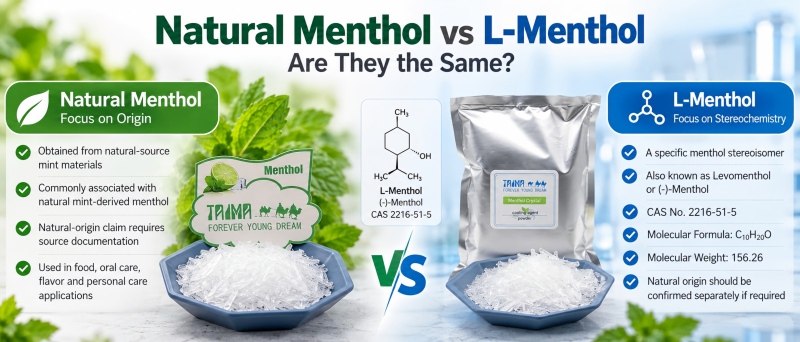
Natural Menthol is menthol obtained from natural-origin raw materials, traditionally from menthol-rich mint oil.
Mentha arvensis, commonly known as cornmint or field mint, is an important commercial source of natural menthol.
Menthol-rich mint oil can be cooled so that naturally occurring menthol crystallizes. The solid menthol crystals are then separated from the remaining liquid mint oil.
This production route is one of the principal ways natural (-)-menthol has traditionally been obtained from mint oil.
View Natural Menthol Product Details >>
Menthol contains several stereogenic centers and can therefore exist in different stereoisomeric forms.
L-Menthol, also known as Levomenthol or (-)-Menthol, refers to the specific menthol stereoisomer commonly identified by CAS No. 2216-51-5.
Its molecular formula is C10H20O and its molecular weight is 156.26.
The (-)-menthol form is the most common naturally occurring menthol enantiomer.
View L-Menthol (Levomenthol) Product Details >>
The easiest way to understand the difference is to separate origin from chemical identity.
The term Natural Menthol indicates that the menthol is obtained from a natural-source production route, such as menthol-rich mint oil.
The term L-Menthol identifies a specific stereoisomer of menthol. It tells the buyer which molecular configuration is being discussed, but the name itself does not prove how the material was produced.
This means that "natural" and "L-" answer different questions.
Natural asks: Where did the material come from?
L-Menthol asks: Which stereochemical form of menthol is it?
Yes, natural menthol obtained from mint sources is predominantly associated with the naturally occurring (-)-menthol form, commonly called L-Menthol or Levomenthol.
However, this does not mean the two terms should always be treated as synonyms.
A natural-origin product can be characterized chemically as L-Menthol, but the natural-origin claim should still be supported by appropriate source and production documentation.
No.
L-Menthol defines the stereochemical form of the molecule rather than the raw material source or manufacturing route.
Industrial processes can also produce (-)-menthol through synthetic manufacturing routes. Therefore, a product described only as L-Menthol should not automatically be assumed to be natural-origin material.
When natural origin is required, buyers should confirm the source separately through the applicable specification and supporting documentation.
Menthol Crystals describes the physical form of a menthol product rather than its complete origin or stereochemical identity.
Natural Menthol may be supplied as crystals, and L-Menthol may also be supplied in crystalline form.
Therefore, the phrase "Menthol Crystals" alone does not provide enough information to determine whether a product is natural, synthetic, L-Menthol or another menthol grade.
Buyers should review the product name, specification, optical rotation, purity and source documentation together.
Optical rotation is an important analytical parameter when evaluating optically active menthol materials because different stereochemical forms interact differently with plane-polarized light.
For example, the current Natural Menthol specification supplied by TAIMA includes an optical rotation range of -50° to -49° at 25°C.
However, optical rotation alone should not be used as the sole proof of natural origin. Natural-origin status also depends on raw material source and manufacturing documentation.
Natural Menthol: Describes the natural origin and production route of the material.
L-Menthol: Describes a specific (-)-menthol stereoisomer.
Natural Menthol Crystals: Natural-origin menthol supplied in crystalline physical form.
L-Menthol Crystals: L-Menthol supplied in crystalline form; natural origin must be confirmed separately if required.
CAS No. 2216-51-5: Identifies L-Menthol / (-)-Menthol / Levomenthol.
Product specifications can vary according to grade, supplier and applicable standard.
For TAIMA's current Natural Menthol grade, selected specification parameters include:
Purity: ≥99.0%
Optical Rotation (25°C): -50° to -49°
Melting Point: 41.0-44.0°C
Appearance: Colorless transparent prismatic or acicular crystals
Standard: GB 1886.199-2016
Batch-specific analytical results should always be confirmed using the corresponding Certificate of Analysis.
When purchasing menthol, buyers should avoid relying on only one product name.
Product Identity: Confirm whether the material is L-Menthol, racemic menthol or another defined menthol grade.
Origin: Confirm whether natural origin is required for the formulation or target market.
Purity: Review the required assay or purity specification.
Optical Rotation: Confirm the specified range when stereochemical identity is relevant.
Melting Point: Check the applicable specification and batch result.
Documentation: Review COA, SDS, product specification and natural-origin documentation where applicable.
The correct choice depends on the formulation and sourcing requirements rather than simply choosing between two product names.
If the project specifically requires a natural-source menthol material, the origin and supporting documentation should be confirmed.
If the requirement is specifically for the (-)-menthol stereoisomer, the L-Menthol identity and applicable analytical specification should be confirmed.
In some projects, both requirements may apply: the buyer may require natural-origin material that also meets an L-Menthol specification.
Not exactly. Natural Menthol describes the source of the material, while L-Menthol describes the stereochemical identity of the menthol molecule.
Yes. L-Menthol, Levomenthol and (-)-Menthol are commonly used names for the same menthol stereoisomer.
No. L-Menthol identifies a stereochemical form and does not by itself establish whether the production route was natural or synthetic.
The CAS number commonly used for L-Menthol, also known as (-)-Menthol or Levomenthol, is 2216-51-5.
No. "Menthol Crystals" primarily describes physical form. Product origin and chemical identity should be confirmed separately.
Yes. Relevant COA, SDS, product specification and sample information can be provided according to the selected menthol grade and project requirements.
Contact us for price, sample, MOQ and OEM support.
✔ Reply within 12 hours
Get Quote on WhatsApp Request SampleWhatsApp: +86 15619038117
Email: alina@taimacn.com
 Alina
Alina