
Sugar reduction is becoming an important formulation direction for beverage, confectionery, dairy, bakery and tabletop sweetener products. However, reducing sugar is not only about replacing sweetness. It may also affect mouthfeel, sweetness onset, sweetness duration, flavor balance and consumer acceptance.
Advantame E969 is a food grade high-intensity sweetener used in sugar-reduced food and beverage formulations. It is approximately 20,000 times sweeter than sucrose, depending on the food application, which means only a very small amount is normally required to reach the target sweetness level.
For food and beverage formulators, Advantame is usually evaluated as part of a complete sweetness system, where dosage accuracy, dispersion, taste balance, processing conditions and local food additive regulations all need to be considered.
If you are looking for commercial supply information, TAIMA also provides Advantame E969 food grade sweetener for sample testing and bulk procurement.
Many food manufacturers need to reduce sugar while keeping the product close to the original sensory profile. This can be challenging because sugar contributes not only sweetness, but also body, texture, flavor release and overall taste balance.
Advantame E969 is selected by formulators mainly because of its very high sweetness potency and low dosage requirement. In many product systems, it can provide strong sweetness contribution without adding a large amount of replacement solids.
Formulation Focus: Because Advantame is used at a very low level, accurate weighing, pre-dilution and uniform dispersion are often more important than simply comparing sweeteners by sweetness intensity.
Approximately 20,000 Times Sweeter Than Sucrose: Advantame provides extremely high sweetness potency, helping formulators reduce the total sweetener dosage in finished formulations.
Low Dosage and Cost-in-Use Advantage: Because only a very small amount is required, Advantame can be evaluated where sweetness intensity, low use level and formula cost efficiency are important.
Suitable for Sugar-Reduced Formulations: It can be used in product development for reduced-sugar beverages, confectionery, dairy products, bakery products, tabletop sweetener blends and flavor systems.
Processing Suitability: Advantame may be evaluated in applications where formulators need better processing suitability than some early-generation sweeteners. Final performance should always be confirmed according to pH, processing temperature and storage conditions.
Sweetener Blending Flexibility: It can be blended with other sweeteners to adjust sweetness onset, sweetness duration, aftertaste and overall taste balance.
Compared with common high-intensity sweeteners, Advantame E969 is mainly selected for its very high sweetness potency and low dosage requirement. This makes it useful for formulators who want to reduce total sweetener addition while still achieving strong sweetness intensity.
Compared with aspartame, Advantame may be evaluated in applications where better processing suitability is required. Compared with sucralose, acesulfame K or neotame, Advantame may offer a different sweetness curve and blending profile depending on the food system.
However, no single sweetener is the best choice for every product. Sucralose, neotame, acesulfame K, aspartame and Advantame may all perform differently depending on pH, heat process, flavor system, sweetness target and local food additive regulations.
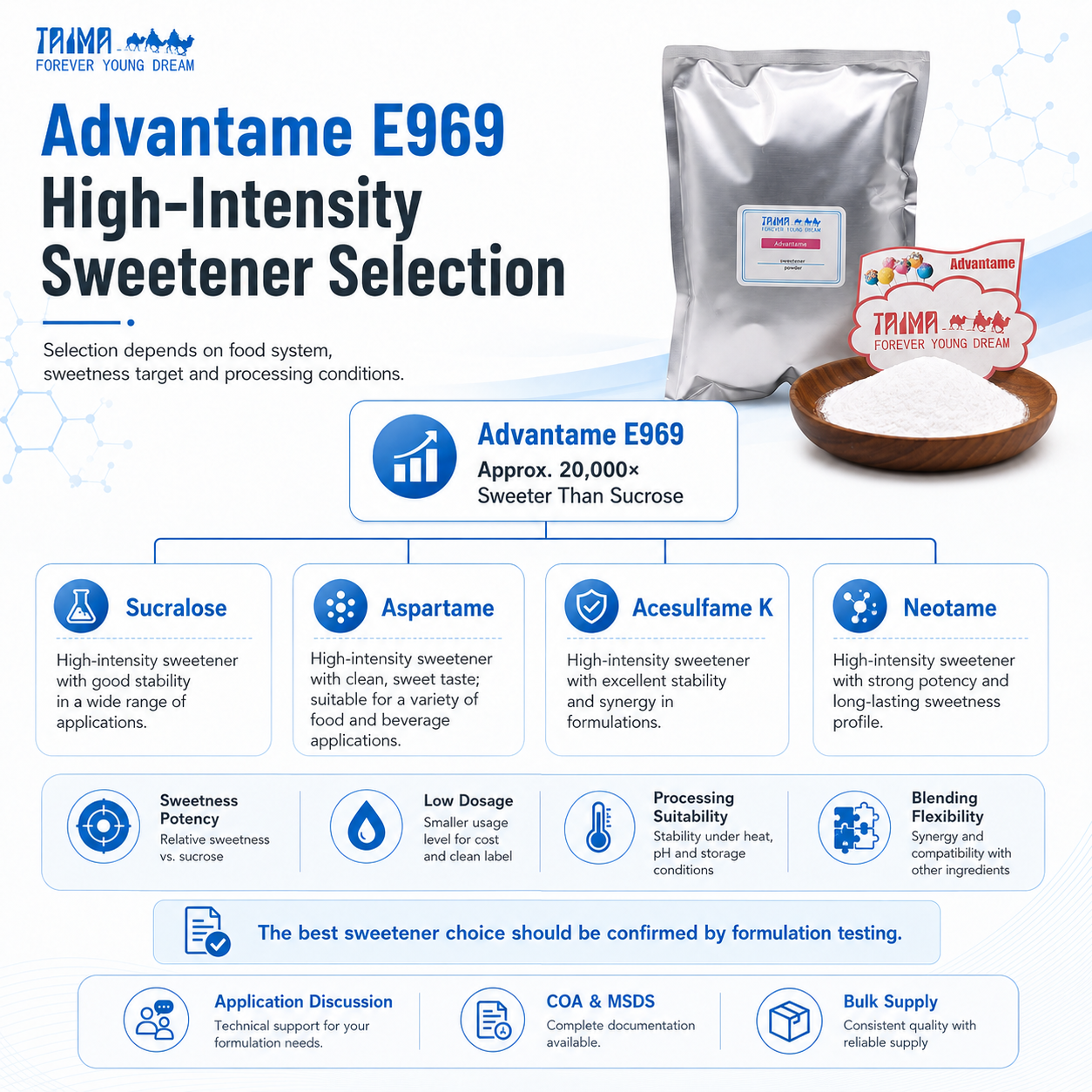
Practical Reminder: Sweetener selection should be based on sensory evaluation, formula cost, processing suitability and regulatory suitability in the destination market.
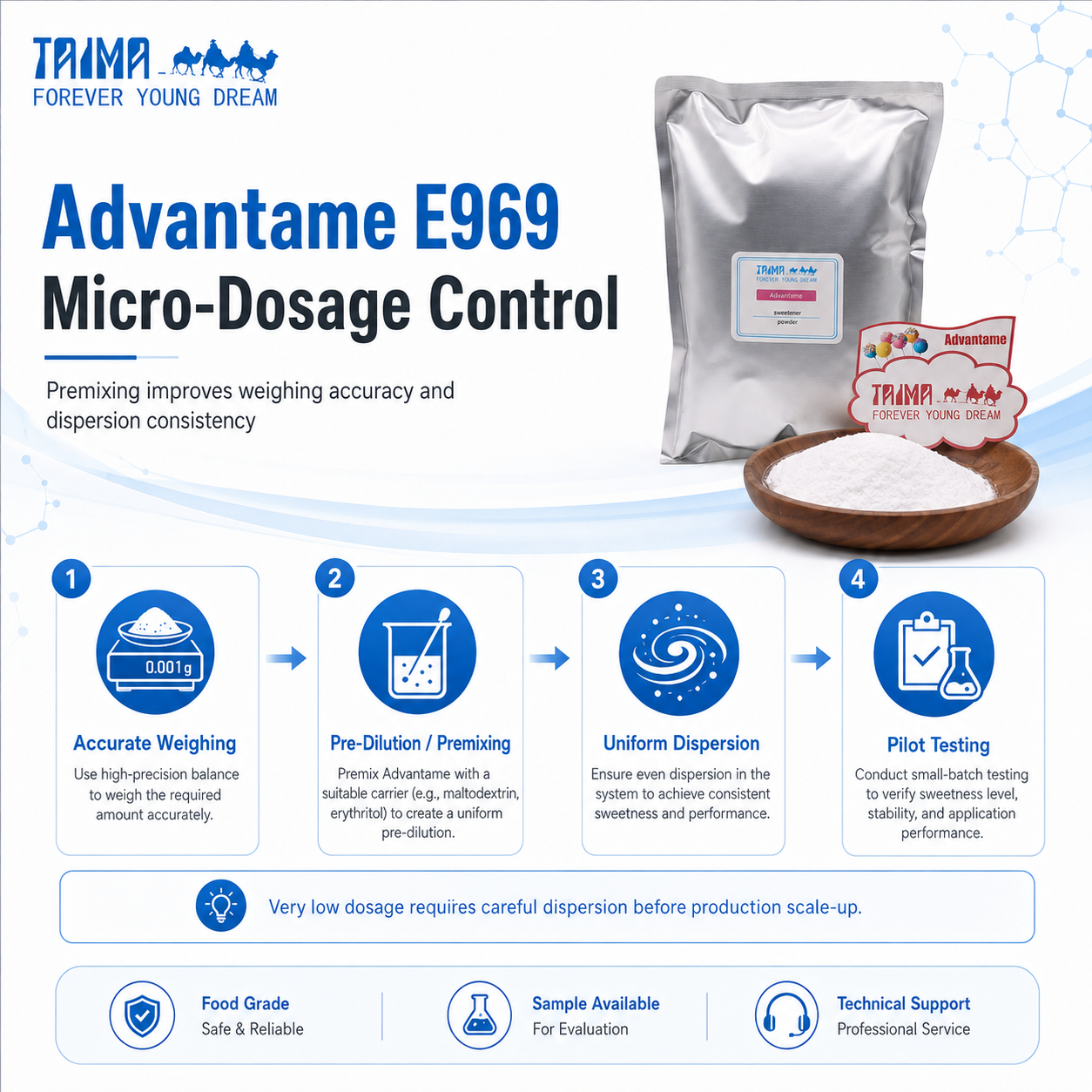
One of the most important formulation points for Advantame E969 is micro-dosage control. Based on its approximate sweetness potency, a very small amount of Advantame may provide sweetness equivalent to a much larger amount of sucrose. This creates a practical production challenge: how to distribute the sweetener evenly in the whole batch.
If Advantame is added directly into a dry blend or a large liquid batch without proper dispersion, the finished product may have inconsistent sweetness. Some parts of the batch may taste too sweet, while other parts may not reach the target sweetness level.
During the R&D phase, formulators often prepare a pre-dilution or premix before adding Advantame into the final product system. For dry applications, it may be blended with a suitable carrier according to the finished product design. For liquid applications, the dissolution and dispersion process should be tested according to the actual production condition.
Scale-Up Note: The premix ratio, carrier selection and addition method should be confirmed by pilot testing. There is no universal ratio suitable for every beverage, candy, bakery, dairy or tabletop sweetener system.
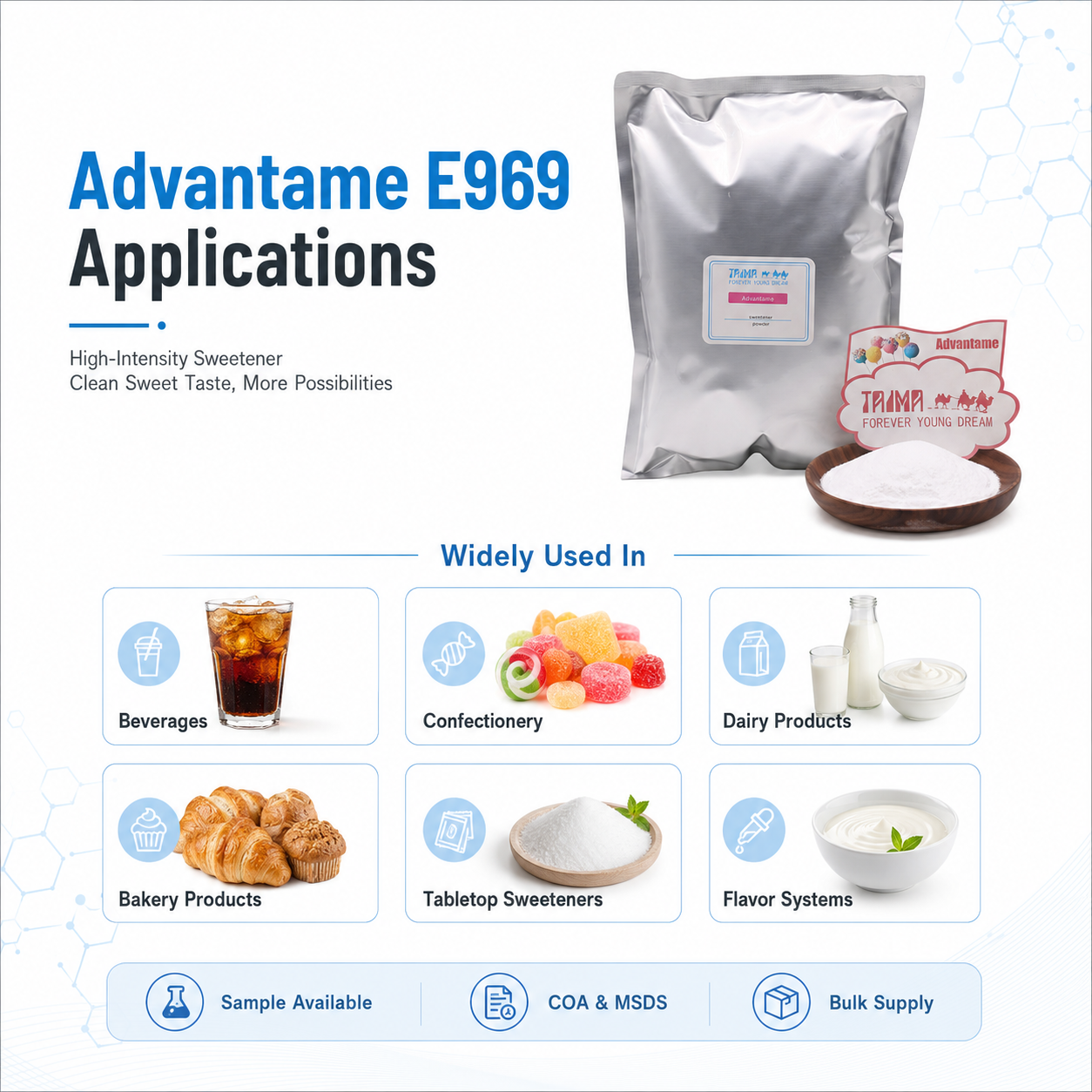
Beverages: carbonated drinks, fruit-flavored drinks, tea drinks, powdered drink mixes and sugar-reduced beverage systems.
Confectionery: hard candies, soft candies, chewing gum, compressed tablets, sweet coatings and sugar-reduced candy formulations.
Dairy Products: yogurt, flavored milk, dairy drinks and frozen desserts.
Bakery Products: cakes, biscuits, fillings and sweet seasoning systems where sweetness adjustment is required.
Tabletop Sweeteners: powder blends, sachets, granules and sweetener premixes.
Flavor Systems: food flavor formulations that need sweetness enhancement or taste profile adjustment.
Beverage Systems: Product pH, acidity, flavor base, processing temperature and storage time may influence sweetness perception. Carbonated beverages, fruit drinks and powdered drink mixes should be tested separately.
Confectionery Systems: Candies, chewing gum and compressed tablets may require careful premixing to avoid uneven sweetness distribution in the final product.
Dairy and Frozen Desserts: Milk proteins, fat content, acidity and flavor type may influence the sweetness curve and aftertaste perception.
Bakery Products: Heat process, moisture level and product structure should be evaluated before commercial use. Advantame performance should be tested under the customer’s actual baking or processing condition.
Tabletop Sweeteners: Carrier selection, particle size, bulk density and flowability are important for powder blends, sachets and premix systems.
High-intensity sweeteners do not always perform best when used alone. In many food and beverage systems, formulators blend different sweeteners to improve sweetness onset, reduce aftertaste, extend sweetness duration or improve the overall flavor profile.
Advantame E969 can be evaluated together with sweeteners such as sucralose, acesulfame K, neotame, sugar alcohols or other sweetness systems. The best combination depends on the target product, sweetness level, flavor base, regulatory market and cost target.
For example, a beverage formulation may require a cleaner sweetness onset, while a chewing gum or compressed tablet may require longer sweetness duration. A bakery or dairy product may need a different balance because heat process, fat content and flavor base can change sweetness perception.
Advantame E969 is used as a food sweetener in many markets, but permitted food categories, maximum use levels and labeling requirements may vary by country or region. Customers should confirm local food additive regulations according to the destination market and final product category.
PKU-related labeling requirements should also be checked according to local rules. TAIMA can provide product documents for customer review, but final regulatory compliance of the finished product should be confirmed by the customer or their regulatory consultant.
Q1: Is Advantame E969 suitable for all food products?
Advantame E969 can be used in many food and beverage applications, but the permitted food categories and maximum use levels may vary by country or region. Customers should confirm the applicable regulation before using it in finished products.
Q2: Can Advantame E969 be used alone?
It can be evaluated alone, but many formulators use it together with other sweeteners to adjust sweetness onset, sweetness duration, mouthfeel and overall flavor balance.
Q3: Why is premixing recommended?
Because Advantame is used at a very low dosage level, premixing can help improve weighing accuracy and dispersion uniformity, especially in dry blends, tablets and powder drink mixes.
Q4: What documents can TAIMA provide?
TAIMA can provide COA, MSDS, specification and product information for customer evaluation and quality review.
Sample Support: Advantame E969 samples can be provided for formulation testing and sweetness evaluation.
Document Support: COA, MSDS, specification and product information can be supplied upon request.
Application Discussion: Basic application suggestions can be provided according to your product type and target market.
Bulk Supply: TAIMA supports sample evaluation, pilot testing and bulk procurement for international customers.
If you are developing sugar-reduced beverages, confectionery, dairy products, bakery products, tabletop sweeteners or flavor systems, TAIMA can provide Advantame E969 sample and quotation support.
View the product page here: Advantame E969 Sweetener Supplier
Please send us your application, estimated quantity, destination country and document requirements. Our team will reply with product information, sample details and quotation.
Contact us for price, sample, MOQ and OEM support.
✔ Reply within 12 hours
Get Quote on WhatsApp Request SampleWhatsApp: +86 15619038117
Email: alina@taimacn.com
 Alina
Alina