
Choosing the right cooling agent is not only about cooling strength. In confectionery, chewing gum, beverages and oral care products, the best cooling system depends on onset speed, cooling duration, sensory location, processing conditions and carrier compatibility. This guide compares WS-23, WS-3, WS-5 and WS-12 to help formulators build cleaner and more controlled cooling profiles.
The demand for clean and refreshing cooling sensations is growing across confectionery, beverages, chewing gum, oral care, and functional flavor applications. Consumers increasingly expect a smooth, long-lasting cooling effect in sugar-free mints, hard candies, functional waters, chewing gum, and lozenges, without the strong medicinal note, bitterness, or burning sensation commonly associated with traditional menthol.
To achieve this type of controlled sensory performance, flavor developers often use synthetic cooling agents from the WS series. Unlike menthol, these cooling agents can provide different cooling speeds, sensory locations, and duration profiles, allowing formulators to build a more precise and layered cooling experience.
Cooling agents do not physically lower the temperature of the mouth. Instead, they create a cooling perception by activating cold-sensitive receptors, especially TRPM8 (Transient Receptor Potential Melastatin 8), which are located on sensory nerve endings in the mouth and throat.
Different cooling molecules interact with the sensory system in different ways. Their molecular structure, polarity, solubility, and formulation carrier can influence how quickly the cooling effect appears, where it is perceived, and how long it remains noticeable during consumption.
For practical formulation work, this means that the best cooling agent is not always the strongest one. The right choice depends on the product format, processing temperature, carrier system, target flavor profile, and the desired sensory curve.
The following table summarizes the typical sensory roles and processing considerations of several commonly used cooling agents in food, beverage, confectionery, chewing gum, and oral care applications.
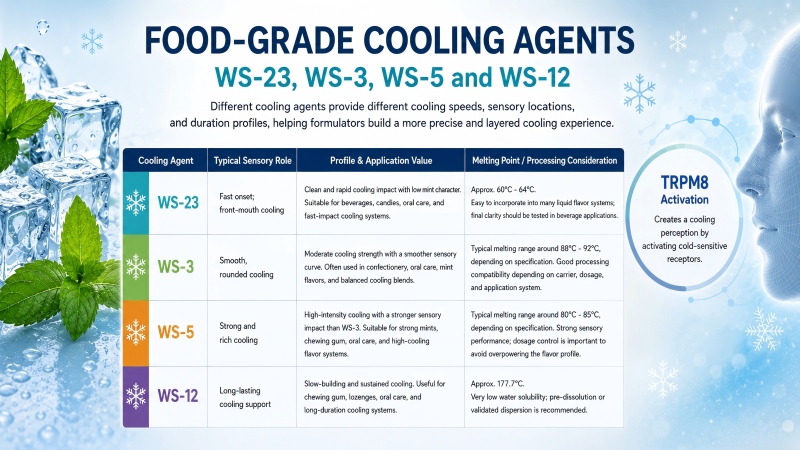 Comparison of WS-23, WS-3, WS-5 and WS-12 cooling agents for beverage, confectionery, chewing gum and oral care applications.
| Cooling Agent | Typical Sensory Role | Profile & Application Value | Melting Point / Processing Consideration |
|---|---|---|---|
| WS-23 | Fast onset, front-mouth cooling | Clean and rapid cooling impact with low mint character. Suitable for beverages, candies, oral care, and fast-impact cooling systems. | Approx. 60°C - 64°C. Easy to incorporate into many liquid flavor systems; final clarity should be tested in beverage applications. |
| WS-3 | Smooth, rounded cooling | Moderate cooling strength with a smoother sensory curve. Often used in confectionery, oral care, mint flavors, and balanced cooling blends. | Typical melting range around 88°C - 92°C, depending on specification. Good processing compatibility depending on carrier, dosage, and application system. |
| WS-5 | Strong and rich cooling | High-intensity cooling with a stronger sensory impact than WS-3. Suitable for strong mints, chewing gum, oral care, and high-cooling flavor systems. | Typical melting range around 80°C - 85°C, depending on specification. Strong sensory performance; dosage control is important to avoid overpowering the flavor profile. |
| WS-12 | Long-lasting cooling support | Slow-building and sustained cooling. Useful for chewing gum, lozenges, oral care, and long-duration cooling systems. | Approx. 177.7°C. Very low water solubility; pre-dissolution or validated dispersion is recommended. |
A single cooling agent may not provide the full sensory experience required in a complex food or beverage matrix. In many applications, formulators use a layered cooling system, where one cooling agent provides fast onset and another supports longer-lasting cooling.
This approach is especially useful in products where the consumer expects both an immediate refreshing impact and a cooling sensation that remains noticeable throughout the consumption cycle.
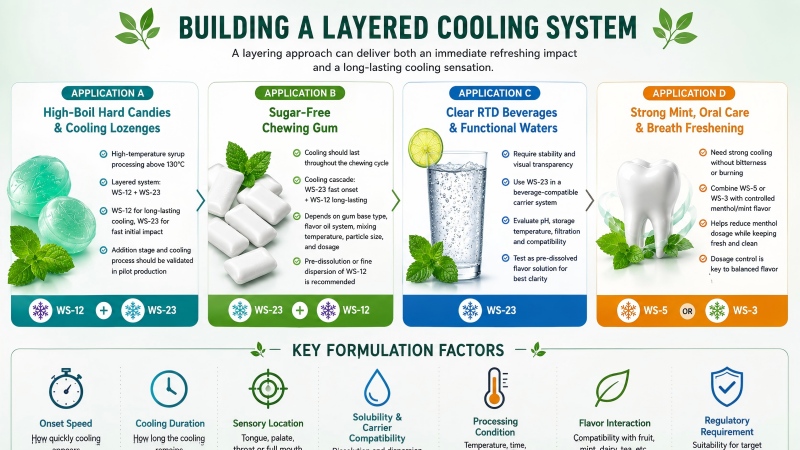 A layered cooling system can combine fast onset and long-lasting cooling for hard candy, chewing gum, beverages and oral care products.
When selecting a cooling agent, formulators should consider more than the cooling strength alone. The following factors strongly influence final product performance:
For international food and flavor applications, buyers should confirm the regulatory status of the cooling agent in the target market. FEMA/JECFA status, local food additive or flavor regulations, recommended use levels, and application-specific restrictions should be reviewed before commercial use.
For example, some WS-series cooling agents have FEMA/JECFA references for flavor use, but the final suitability should always be confirmed according to the target market, application category, and recommended use level.
A reliable supplier should provide complete technical and quality documentation, including COA, SDS, product specification, allergen statement, Halal or Kosher certificates where required, and third-party test reports when requested by the final customer.
GC purity is an important quality-control indicator, but it should not be described as a guarantee of complete impurity elimination. A high-purity GC profile can support impurity control, batch consistency, and sensory reliability, but final performance should still be verified in the customer's actual formulation system.
| Application Goal | Recommended Cooling Agent | Reason |
|---|---|---|
| Fast and clean cooling for beverages | WS-23 | Quick onset, clean cooling, low mint character, suitable for refreshing drink systems after carrier validation. |
| Smooth and balanced cooling for confectionery | WS-3 | Moderate cooling intensity with a rounded profile, suitable for balanced mint and fruit flavor systems. |
| Strong cooling for oral care and breath freshening | WS-5 | High sensory intensity, suitable for strong mint, chewing gum, toothpaste, and mouth-refreshing products. |
| Long-lasting cooling for gum and lozenges | WS-12 | Slow-building and sustained cooling profile, useful for long-duration cooling applications. |
| Fast onset plus long-lasting cooling | WS-23 + WS-12 | WS-23 provides quick impact, while WS-12 supports a longer cooling curve. |
For B2B buyers, the most important factor is not only the price of the cooling agent, but also the supplier's ability to support formulation evaluation, quality consistency, export documentation, and application-specific technical communication.
Choosing the right cooling agent is a technical decision. A well-designed cooling system should match the product format, processing condition, flavor profile, and target sensory experience.
Contact us for price, sample, MOQ and OEM support.
✔ Reply within 12 hours
Get Quote on WhatsApp Request SampleWhatsApp: +86 15619038117
Email: alina@taimacn.com
 Alina
Alina