
L-Isopulegol and L-Menthol belong to closely related mint-associated chemical families, which is why they are often discussed together. However, they should not be treated as interchangeable ingredients.
In practical formulation, the main difference is what role the ingredient is expected to play. Isopulegol is primarily valued for its fresh, minty and herbal aroma character, while Menthol is widely selected when a more recognizable mint profile and direct cooling sensation are required.
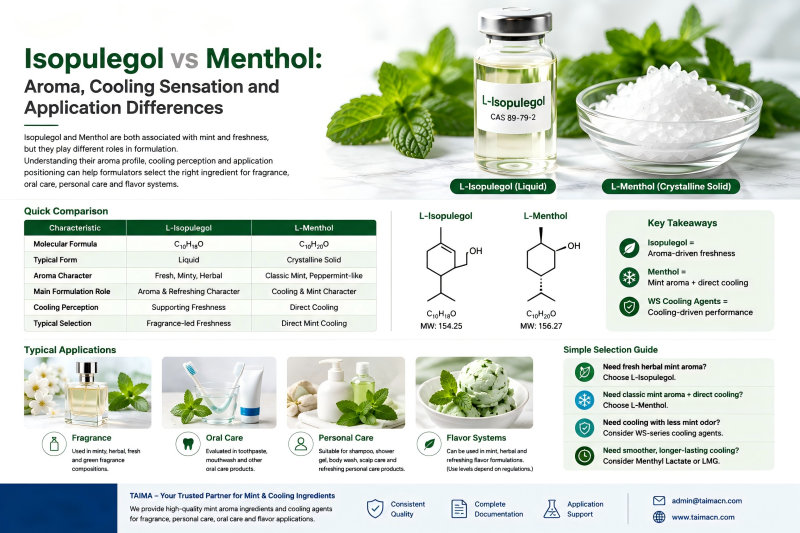
The two ingredients share a mint-related sensory direction, but their primary formulation roles are different. The comparison below highlights the key distinctions.
| Characteristic | L-Isopulegol | L-Menthol |
|---|---|---|
| Molecular Formula | C10H18O | C10H20O |
| Typical Form | Liquid | Crystalline Solid |
| Aroma Character | Fresh, Minty, Herbal | Classic Mint, Peppermint-like |
| Main Formulation Role | Aroma & Refreshing Character | Cooling & Mint Character |
| Cooling Positioning | Refreshing sensory support | Direct recognizable cooling |
| Typical Selection | Aroma-driven freshness | Classic mint cooling |
L-Isopulegol is a mint-related monoterpene alcohol with a fresh, minty and herbal sensory profile. In fragrance and personal care systems, it is mainly valued as an aroma ingredient that contributes freshness and a clean herbal-mint character.
Its role is therefore different from that of a dedicated high-performance cooling agent. Although the aroma can support a refreshing sensory impression, formulators generally select Isopulegol because of its aroma profile and freshness contribution rather than simply for maximum cooling intensity.
L-Menthol is one of the most widely recognized mint-related ingredients. It has a characteristic peppermint-like odor and provides a direct, recognizable cooling sensation.
This combination of aroma and cooling performance makes Menthol particularly suitable when cooling itself is an important part of the finished product experience.
Isopulegol offers a fresher and more herbal interpretation of mint. Its aroma can contribute green, clean and refreshing characteristics without necessarily making the finished formulation smell strongly of conventional Menthol.
Menthol has a more recognizable classic mint character. In many formulations, its characteristic aroma can strongly influence the overall mint identity of the finished product.
Key Point: Both ingredients are mint-related, but they do not create the same type of mint profile. Isopulegol leans toward fresh and herbal character, while Menthol gives a more classic and immediately recognizable mint impression.
Cooling is one of the most important practical differences between the two ingredients.
Menthol is commonly selected when a direct and recognizable cooling sensation is required. Its sensory effect is closely associated with the familiar cooling experience of mint.
Isopulegol, by contrast, is better positioned as an aroma ingredient contributing a fresh and refreshing sensory character. It should not automatically be treated as a direct substitute for Menthol or for dedicated cooling agents such as WS-series ingredients.
Simple formulation view:
• Isopulegol = Aroma-driven freshness
• Menthol = Mint aroma + direct cooling
• WS Cooling Agents = Cooling-driven sensory performance
Physical form can also influence formulation handling and processing.
L-Isopulegol is typically supplied as a liquid, which can make weighing, premixing and incorporation convenient in many fragrance and liquid formulation systems.
L-Menthol is typically a crystalline solid under normal room-temperature conditions. Depending on the formulation, it may require dissolution or suitable processing conditions before incorporation.
Actual processing conditions should always be determined according to the complete formulation, carrier system and production process rather than using one universal temperature or dosage recommendation.
• A fresh and herbal mint aroma is desired.
• The formulation is more fragrance-driven than cooling-driven.
• A refreshing sensory profile is required without making classic Menthol the dominant aroma.
• The product concept focuses on clean, green or fresh personal care positioning.
• Direct cooling sensation is required.
• A recognizable peppermint-like profile is desirable.
• Cooling is an important part of the finished product experience.
• The formulation needs both mint character and cooling perception from one ingredient.
• Aroma character and cooling intensity need to be adjusted separately.
• A more layered mint profile is required.
• The formulation needs both herbal freshness and recognizable mint cooling.
Isopulegol can be useful in fresh, herbal, green and mint fragrance compositions where aroma structure is the main consideration. Menthol is more suitable when both characteristic mint odor and cooling perception are desired.
Both ingredients can contribute to mint-based oral care concepts. Isopulegol can help build freshness and aroma complexity, while Menthol is commonly associated with the direct cooling impression expected in many toothpaste and mouthwash formulations.
In shampoo, scalp care, shower gel and body care formulations, Isopulegol can support clean and refreshing fragrance concepts. Menthol may be preferred when the consumer is expected to perceive a stronger cooling sensation.
In mint and herbal flavor systems, the final choice depends on the desired aroma profile and cooling effect. Regulatory suitability and use level should always be confirmed for the intended market and finished product.
Isopulegol and Menthol are not the only options available when designing a refreshing sensory profile. When stronger, cleaner or longer-lasting cooling is required, formulators may consider dedicated cooling ingredients.
| Isopulegol | Fresh minty-herbal aroma and refreshing character |
| Menthol | Classic mint aroma with direct cooling sensation |
| Menthyl Lactate | Mild and longer-lasting cooling profile |
| L-Monomenthyl Glutarate | Smooth and persistent cooling sensation |
| WS-Series Cooling Agents | Cooling-focused solutions with different onset, intensity and duration profiles |
Need a fresh herbal mint aroma?
L-Isopulegol may be a suitable starting point.
Need classic mint aroma with direct cooling?
Consider L-Menthol.
Need cooling with less dependence on mint aroma?
Consider WS-series cooling agents.
Need smoother, longer-lasting cooling?
Menthyl Lactate or L-Monomenthyl Glutarate may be worth evaluating.
No. They are different chemical substances with different molecular structures, physical forms and sensory profiles.
Isopulegol contributes a fresh and refreshing sensory character, but it is generally better positioned as an aroma ingredient rather than as a dedicated high-performance cooling agent.
Not necessarily. The choice depends on whether the formulation primarily requires herbal-minty aroma, direct cooling, classic mint character or a combination of these effects.
They can be evaluated together when a formulation requires both aroma complexity and cooling perception. Final compatibility and dosage should be confirmed through formulation testing.
For aroma-driven freshness, Isopulegol may be suitable. For stronger direct cooling, Menthol or dedicated cooling agents may be more appropriate. The final choice depends on the desired sensory profile and formulation system.
L-Isopulegol – Fresh minty and herbal aroma ingredient
Menthyl Lactate – Mild and long-lasting cooling ingredient
L-Monomenthyl Glutarate – Smooth persistent cooling ingredient
WS-Series Cooling Agents – Cooling-focused ingredients for different sensory requirements
TAIMA supplies L-Isopulegol, Menthyl Lactate, L-Monomenthyl Glutarate and WS-series cooling agents for different aroma and cooling profiles. Contact us for samples, specifications and formulation evaluation support.
Contact us for price, sample, MOQ and OEM support.
✔ Reply within 12 hours
Get Quote on WhatsApp Request SampleWhatsApp: +86 15619038117
Email: alina@taimacn.com
 Alina
Alina