
For products such as chewing gum, hard candy, toothpaste, mouthwash, beverage flavors and personal care formulations, cooling ingredients should be selected according to the expected cooling onset, duration, smoothness, mint impact and compatibility with the complete formula.
A strong cooling impact can create an immediate refreshing impression, but it may not always provide the best sensory experience. In some formulations, a fast and sharp cooling effect disappears too quickly or interferes with the desired flavor profile.
Long-lasting cooling is especially important when the product is expected to deliver freshness over time. This is common in oral care, chewing gum, mint confectionery, refreshing beverages and selected personal care applications.
For this reason, many formulators design a cooling system instead of using only one cooling agent. A cooling system may combine different ingredients to balance cooling strength, duration and sensory comfort.
Cooling intensity and cooling duration are two different sensory dimensions. Cooling intensity describes how strong the cooling effect feels, while cooling duration describes how long the cooling perception remains noticeable after application or consumption.
When evaluating a cooling formula, formulators usually consider several factors:
• Cooling onset: how quickly the cooling sensation appears
• Cooling intensity: how strong the cooling effect feels
• Cooling duration: how long the cooling sensation remains
• Mint impact: whether the ingredient changes the original flavor direction
• Smoothness: whether the cooling effect feels clean, sharp, soft or balanced
• Formula compatibility: whether the ingredient performs well in the finished product system
A good cooling design usually balances these points instead of focusing only on maximum cooling strength.
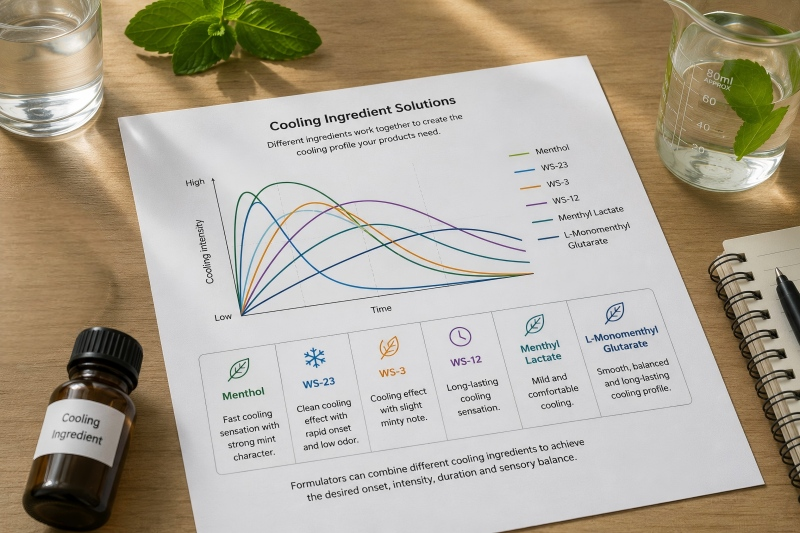
Menthol is a classic cooling ingredient and remains useful in many formulations. It provides a recognizable mint character and a clear cooling sensation. However, menthol may not be suitable for every product direction.
In some formulations, menthol may bring a strong mint note, a sharp sensory impact or a cooling profile that is not long enough for the target product experience. When the main flavor is fruit, beverage, candy, cream or non-mint personal care, excessive mint character may interfere with the overall sensory design.
This is why many formulators evaluate other cooling ingredients such as WS-23 cooling agent, WS-12 cooling agent, Menthyl Lactate cooling agent and L-Monomenthyl Glutarate cooling ingredient to build a more controlled cooling profile.
Different cooling ingredients have different sensory characteristics. Choosing the right ingredient depends on the application, flavor direction and expected cooling curve.
WS-23
WS-23 cooling agent is often evaluated when a clean, direct and low-odor cooling effect is desired. It is suitable for formulations that need a clear cooling impact without strong mint character.
WS-12
WS-12 cooling agent is commonly considered for longer cooling duration. It may be useful when persistence and cooling after-feel are important in the target product.
Menthyl Lactate
Menthyl Lactate cooling agent provides a mild and comfortable cooling sensation. It is often evaluated in oral care, personal care and selected flavor systems where a softer cooling profile is preferred.
L-Monomenthyl Glutarate
L-Monomenthyl Glutarate cooling ingredient may be selected when formulators need a smooth, persistent and low-mint-impact cooling profile. It can be considered for refined cooling systems where long-lasting freshness and low flavor interference are desired.
Cooling ingredient selection should be adjusted according to the application. The same cooling ingredient may perform differently in chewing gum, beverage flavors, oral care products or personal care formulations.
Toothpaste, mouthwash and breath freshening products often require a cooling effect that feels clean and remains noticeable after use. In these applications, formulators may evaluate WS-3, WS-12, Menthyl Lactate and L-Monomenthyl Glutarate depending on the desired freshness profile.
Chewing gum, hard candy and mint confectionery often require both immediate cooling and lasting freshness. WS-23 may support clean cooling impact, while WS-12 and L-Monomenthyl Glutarate may help extend the cooling perception and improve sensory balance.
For beverage flavor systems, formulators should pay attention to solubility, flavor compatibility and cooling release in the final product. A cooling ingredient that works well in confectionery may need further evaluation in beverage applications.
In personal care products, cooling comfort and skin feel are important. Menthyl Lactate, L-Monomenthyl Glutarate and other cooling ingredients may be evaluated in suitable personal care systems, depending on the product type, use level, formulation base and local regulatory requirements.
Before commercial production, cooling ingredients should be tested in the actual formula. Sensory performance may vary depending on dosage, base material, flavor composition, processing conditions and finished product format.
A practical evaluation process may include:
• Start with small-scale lab evaluation
• Compare single cooling ingredient and blended cooling system
• Evaluate cooling onset, intensity, duration and after-feel
• Check solubility and compatibility with the formula base
• Confirm whether the ingredient affects the main flavor profile
• Confirm dosage, labeling and compliance according to the final product and local regulations
This step is especially important for products that need a specific cooling curve rather than a simple strong cooling effect.
L-Monomenthyl Glutarate can be considered when the formulation requires a cooling sensation that is smooth, persistent and less dominated by mint character. It may be useful for products where formulators want to improve cooling duration without making the flavor profile too sharp.
It is especially worth evaluating when the target product needs:
• Long-lasting freshness
• Smooth cooling sensation
• Low mint interference
• Balanced cooling curve
• Combination with WS-23, WS-12 or Menthyl Lactate
For more product-specific information, please visit our L-Monomenthyl Glutarate cooling ingredient page.
Cooling duration is influenced by the type of cooling ingredient, dosage, formulation base, solubility and interaction with flavor components. Ingredients with a longer cooling profile may help extend the refreshing sensation.
WS-23 is often evaluated for clean cooling with low odor impact, while L-Monomenthyl Glutarate may be considered when a smooth cooling profile with light mint character is preferred. The final choice should be tested according to the target application and flavor direction.
Yes. Cooling ingredients are often combined to balance onset, intensity, duration and smoothness. A blended cooling system may provide a more complete sensory profile than a single ingredient.
Yes. Oral care products often require a fresh sensation that remains noticeable after use. Cooling ingredients should be evaluated for freshness duration, comfort, flavor compatibility and regulatory suitability.
TAIMA can provide cooling ingredient information, samples and technical documents for formulation evaluation. Contact us to discuss suitable cooling ingredient options for your application.
Contact us for price, sample, MOQ and OEM support.
✔ Reply within 12 hours
Get Quote on WhatsApp Request SampleWhatsApp: +86 15619038117
Email: alina@taimacn.com
 Alina
Alina